Notice · content is for research purposes. The peptides described are not approved for human consumption and do not constitute medical advice.
4 citations·Reviewed 23 May 2026
Share
In short: The primary difference between a lyophilized peptide and a pre-filled pen lies in molecular stability and degradation kinetics. Lyophilized (freeze-dried) powders halt hydrolytic processes, allowing for storage at room temperature for months, whereas pre-filled liquid solutions offer immediate dosing readiness but require a strict cold chain due to their rapid half-life in aqueous environments.
What are the formats: lyophilized peptide vs pre-filled pen
The choice of physical state for storing peptide molecules determines their shelf life, purity, and applicability in in vitro and in vivo models.
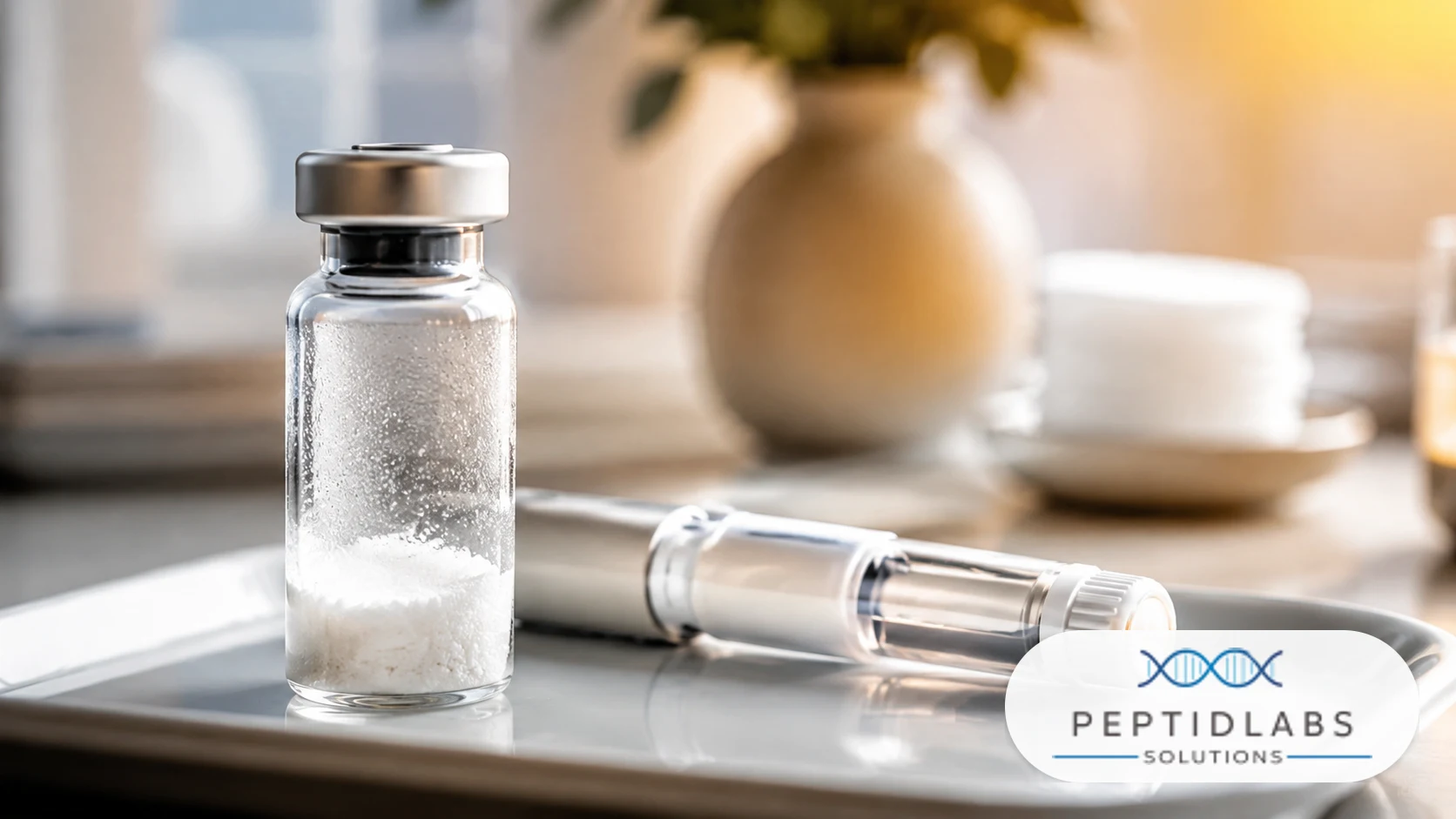
Comparison between a glass vial with white lyophilized powder and a pre-filled peptide pen with clear liquid
When Bruce Merrifield introduced solid-phase peptide synthesis (SPPS) in the 1960s, earning him a Nobel Prize in 1984, the synthesized chains required immediate use or deep freezing [1]. Decades later, Lotte Bjerre Knudsen's team developed acylation techniques that allowed molecules like Semaglutide to withstand aqueous environments long enough to be packaged in liquid dispensers.
Lyophilization is a sublimation process where water is removed from the peptide solution under low temperatures and vacuum. The result is a stable, porous structure (often called a "cake") containing the active molecule and excipients like mannitol or sucrose, which act as cryoprotectants. This format is the standard in biochemical laboratories because it halts chemical reactions that require water as a mediator.
On the other hand, pre-filled pens represent a pre-mixed aqueous solution of the peptide, buffered to a specific pH (usually between 7.0 and 8.2) and preserved with agents like phenol or metacresol. These formats are designed for phase 3 clinical trials, where dosing consistency by subjects takes priority over the long-term shelf stability of the molecule.
Mechanism of action and degradation of lyophilized peptides vs liquid
Understanding degradation pathways is critical for any researcher working with amino acid sequences.
Graph of hydrolytic degradation of peptide bonds in aqueous environments versus lyophilized state at various temperatures
Hydrolysis and deamidation in aqueous environments
The moment a peptide comes into contact with water, its degradation clock starts. Water molecules attack peptide bonds via hydrolysis. The most vulnerable points in the peptide chain are the asparagine (Asn) and glutamine (Gln) residues. In an aqueous environment, these amino acids undergo deamidation, converting into aspartic acid and glutamic acid, respectively. This process alters the molecule's isoelectric point and often leads to a complete loss of receptor affinity.
If you are working with in vitro cell cultures, you must ensure the exact molar concentration of the active agent. When using liquid formats stored outside a refrigerator for more than 14 days, the concentration of the intact peptide can drop by over 15% due to hydrolytic cleavage. Lyophilized formats bypass this issue by eliminating water as the reaction medium.
Oxidation and aggregation
Oxidation primarily affects methionine (Met), tryptophan (Trp), and histidine (His) residues. In liquid pens, dissolved oxygen and light exposure accelerate the formation of methionine sulfoxide. Furthermore, physical movement (shaking) of liquid peptide solutions induces mechanical stress at the air-liquid interface, leading to the formation of beta-sheet structures and insoluble aggregates (fibrillization).
"The stability of peptides in aqueous solution is inversely proportional to temperature and exposure time; lyophilization extends the molecule's half-life from an average of 30 days to over 730 days when stored properly."
Published research and laboratory stability data
Scientific literature provides clear quantitative data on the stability differences between the two formats.
Laboratory table showing loss of peptide purity at 25 degrees Celsius over different time intervals
When reviewing data from large-scale trials, liquid formats show remarkable efficacy due to their convenience. In the STEP-1 trial (published in the New England Journal of Medicine, 2021), Semaglutide in liquid form demonstrated a 14.9% reduction in body mass at week 68 [2]. Similar results were observed in SURMOUNT-1 (2022), where Tirzepatide achieved a 22.5% reduction at week 72 [3]. These trials utilized pre-filled pens, but their logistics required strict maintenance of temperatures between 2°C and 8°C until the first use.
For research purposes, where molecules are often transported globally and stored for months prior to an experiment, lyophilized peptides exhibit a superior stability profile.
Stability Parameter
Lyophilized Powder (in vial)
Liquid Solution (in pen)
Shelf life at -20°C
24 to 36 months
Not recommended (risk of aggregation upon freezing)
Stability at 4°C (Fridge)
12 to 24 months
Typically 30 to 56 days after first use
Stability at 25°C (Room temp.)
30 to 60 days (minimal degradation)
Rapid degradation after 14 to 21 days
Sensitivity to shaking
Low
High (risk of fibrillization)
Studies on the stability of lyophilized peptides indicate that as long as the vacuum is maintained and moisture is absent, the molecule's purity (typically over 99% according to HPLC analysis) remains unchanged even during short-term exposure to temperatures up to 37°C during transit.
Practical context: Peptide reconstitution guide and working with pre-filled formats
Preparing the experimental environment requires strict adherence to reconstitution and dosing protocols.
To use a lyophilized peptide, you must first restore it to a liquid state. This process, known as reconstitution, is most commonly performed using Bacteriostatic Water 10ml. Bacteriostatic water contains 0.9% benzyl alcohol, which prevents bacterial growth and allows the solution to remain sterile for up to 28 days in a refrigerator.
When setting up an experiment, precision is key. Researchers frequently use a Reconstitution calculator to determine the exact ratio between peptide micrograms and solvent milliliters. An important rule in laboratory practice is to add the solvent slowly, directing the stream against the glass wall of the vial rather than directly onto the powder. Shaking is contraindicated; the vial should be swirled gently between the fingers until the solution becomes completely clear.
Regarding liquid formats, search terms like "weight loss peptide pens" or "pre-filled peptide pen reviews" often reflect interest in the clinical application of GLP-1 agonists. In laboratory settings, however, pre-filled pens have limitations. They do not allow the researcher to alter the solution's concentration or mix different peptides in the same buffer for combined in vitro assays. The lyophilized format provides complete control over the molarity of the final solution, which is invaluable when constructing dose-response curves.
Frequently asked questions
What is the main difference between a lyophilized peptide and a pre-filled pen?
The main difference is the physical state and the presence of water. A lyophilized peptide is a dried powder under vacuum, which halts chemical degradation and allows for long-term storage. A pre-filled pen is a pre-mixed aqueous solution that is convenient for immediate dosing but has a significantly shorter shelf life.
How long do lyophilized peptides last at room temperature?
In their lyophilized (powdered) state and protected from direct sunlight, most peptides retain over 98% of their purity at room temperature (25°C) for a period of 30 to 60 days. This makes them highly resilient during transport. However, once reconstituted, they must be stored in a refrigerator.
Why do pre-filled pens degrade faster?
The presence of water in pre-filled pens acts as a mediator for chemical reactions like hydrolysis and deamidation. These processes slowly break the peptide bonds. Additionally, liquid solutions are more susceptible to aggregation caused by mechanical shaking and temperature fluctuations.
Is bacteriostatic water mandatory when reconstituting peptide powders?
For in vitro research or models that require drawing multiple doses from the same vial over days or weeks, bacteriostatic water is highly recommended. The benzyl alcohol in it prevents contamination. If the experiment requires using the entire contents immediately in a single instance, sterile water for injection may be used.
Can I freeze the peptide after it has been reconstituted?
Most research protocols do not recommend freezing peptides after their reconstitution. The process of freezing and subsequent thawing of an aqueous solution can cause ice crystallization, which physically disrupts the peptide chains and leads to aggregation, reducing the molecule's efficacy.
Conclusion
Understanding the biochemical differences between a lyophilized peptide and a pre-filled pen is foundational for conducting proper peptide research. While liquid formats offer logistical ease for clinical trials with large subject cohorts, lyophilization remains the gold standard for molecular stability in the research laboratory. By eliminating the aqueous environment, lyophilized powders protect amino acid sequences from hydrolysis and oxidation, ensuring that in vitro and in vivo models receive the precise molar concentration of the intact peptide. Selecting the correct solvent and accurately calculating doses completes a successful experimental design.
References
[1] Merrifield, R. B. (1963). Solid Phase Peptide Synthesis. I. The Synthesis of a Tetrapeptide. Journal of the American Chemical Society, 85(14), 2149-2154.
[2] Wilding, J. P. H., et al. (2021). Once-Weekly Semaglutide in Adults with Overweight or Obesity (STEP-1). The New England Journal of Medicine, 384(11), 989-1002. PMID: 33567185
[3] Jastreboff, A. M., et al. (2022). Tirzepatide Once Weekly for the Treatment of Obesity (SURMOUNT-1). The New England Journal of Medicine, 387(3), 205-216. PMID: 35658024
[4] Knudsen, L. B., & Lau, J. (2019). The Discovery and Development of Liraglutide and Semaglutide. Frontiers in Endocrinology, 10, 155. PMID: 31031702